Abstract
Robots are increasingly deployed across diverse domains and designed for multi-purpose operation. As robotic systems grow in complexity and operate in dynamic environments, the need for structured, expressive, and scalable mission-specification approaches becomes critical, with mission specifications often defined in the field by domain experts rather than robotics specialists. However, there is no standard or widely accepted formalism for specifying missions in single- or multi-robot systems. A variety of formalisms, such as Behavior Trees, State Machines, Hierarchical Task Networks, and Business Process Model and Notation, have been adopted in robotics to varying degrees, each providing different levels of abstraction, expressiveness, and support for integration with human workflows and external devices. This work presents a systematic analysis of these four formalisms with respect to their suitability for robot mission specification. Our study focuses on mission-level descriptions rather than robot software development. We analyze their underlying control structures and mission concepts, evaluate their expressiveness and limitations in modeling real-world missions, and assess the extent of available tool support. By comparing the formalisms and validating our findings with experts, we provide insights into their applicability, strengths, and shortcomings in robotic system modeling. The results aim to support practitioners and researchers in selecting appropriate modeling approaches for designing robust and adaptable robot and multi-robot missions.
Formalisms
Research Questions
Methodology
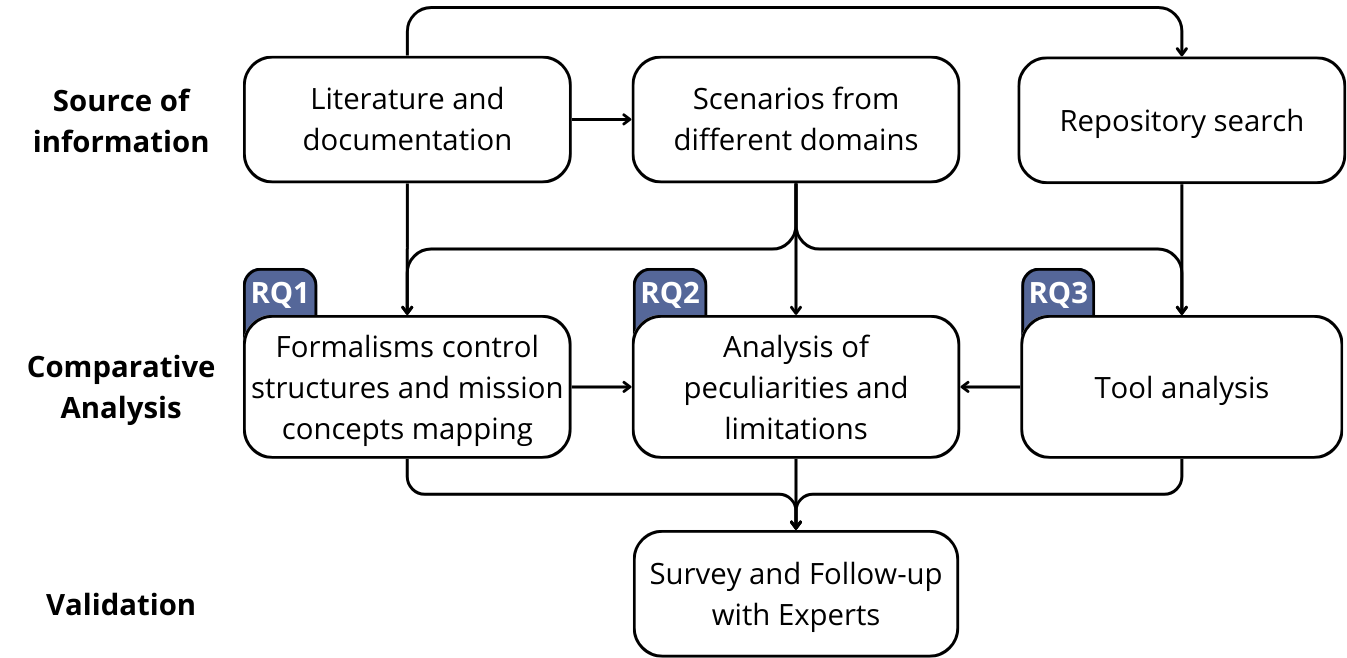
Our study follows a three-phase research method. First, we conducted a targeted literature review and analyzed the primary documentation of the four considered formalisms: Behavior Trees (BT), State Machines (SM), Hierarchical Task Networks (HTN), and Business Process Model and Notation (BPMN), to identify their control structures and mission-level abstractions. Second, we modeled eleven robotic mission scenarios spanning multiple domains (e.g., healthcare, logistics, agriculture) using each formalism. This enabled a systematic comparison of their expressiveness, peculiarities, and limitations in realistic mission specifications. We also analyzed publicly available tools supporting each formalism. Finally, we validated our findings through a structured questionnaire survey and follow-up discussions with domain experts, assessing completeness, correctness, and alignment with established practice.